
We once watched an old orchard struggle through a season — yellowing leaves, thin branches, and a grower who kept repeating, “Give the soil a chance to breathe.” The next spring, he added a light layer of limestone. Nothing dramatic happened at first, but over the following months the change was unmistakable: thicker shoots, richer color, and trees that finally looked alive again.
That’s what limestone really does — not a flashy miracle, but a slow, steady correction that helps trees grow the way they’re meant to.
The Real problem Limestone solves..
Soils that are too acidic lock up nutrients and can release elements (like aluminum and manganese) that hurt roots. Limestone — ground calcium carbonate (or calcium-magnesium carbonate if it’s dolomitic) — raises pH, reduces those toxic ions, and frees phosphorus and other nutrients so roots can actually take them up.
In short: lime fixes a chemical bottleneck that fertilizer alone often cannot. The pattern shows up again and again in extension bulletins and global reviews (A 2023 global review): when acidity limits growth, liming typically improves soil pH and often increases plant productivity.
Start here — Test, don’t guess
This is where most readers lose patience, but it’s the single most important step: Get a soil test that reports both pH and a buffer- or SMP-based lime requirement. That lab number tells you:
- Whether lime is needed at all,
- What target pH to aim for (often ~6.2–6.8 for most trees), and
- The pounds/acre (or kg/ha) to move your soil toward that target.
Pros convert the lab’s lime requirement into purchase units using the lime’s neutralizing value (CCE) and particle-size notes.
We warn you.. If you skip the test, you risk wasting money or creating new nutrient problems.
Choosing the right lime: calcitic vs. dolomitic
Next comes another tricky confusion. That is whether to choose calcite lime or dolomitic lime.
Generally, there are two common farm choices in limestone:
Calcitic lime — supplies calcium (Ca). Use this when magnesium (Mg) levels are adequate.
Dolomitic lime — supplies calcium and magnesium (Mg). Choose this if your soil test shows a magnesium deficiency.
Both neutralize acidity, but the magnesium bonus is why dolomitic is chosen when Mg is low. Also check the lime’s neutralizing value and particle size: finer materials and higher CCE act faster.
How to apply Limestone? The practical, Homeowner-to-Orchardist approach
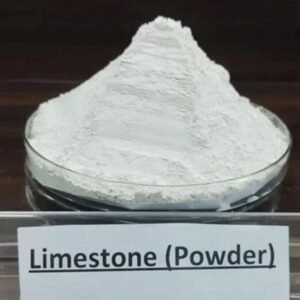
When it comes to using limestone, think of it in two ways: pre-plant correction and ongoing maintenance. The method you choose depends on whether you’re preparing soil before planting a tree or trying to improve the soil under trees that are already growing.
If you’re preparing the soil before planting (this gives the best results):
Before a tree ever goes into the ground, you have the perfect chance to fix the soil’s pH. This is when limestone works most efficiently.
- Mix the recommended amount of lime into the top 8–16 inches of soil.
- Trees planted in soil with the right pH grow stronger roots from the very beginning, which means fewer problems and fewer heavy corrections later.
This is the method most university extension guides and orchard managers recommend because it creates long-term stability for the tree.
If your trees are already planted:
You can still improve the soil, just in a gentler way.
- Spread the lime evenly across the entire root zone — basically, the area from the trunk out to the dripline (where rain naturally falls off the canopy).
- Avoid dumping lime directly against the trunk; roots need it, not bark.
If your soil test shows that you need a large amount of lime, don’t dump it all in one go. Heavy applications can overwhelm the surface layer and take much longer to react. A better approach — and the one experienced growers prefer — is to split the total amount into two rounds. Apply half of it this season, let the soil begin adjusting, and then apply the remaining half the following season. This slower, staged method helps the pH rise more evenly and gives the soil time to respond without shocking the system.
How long before you see results?
Limestone works slowly. Expect the first measurable pH change in a few months, most change within about a year, and full equilibration in two to three years, depending on soil texture, organic matter, and lime fineness. Finer materials and mechanical incorporation speed things up; coarse, surface-only applications take the longest.
On the whole, plan liming as a long-term soil-health investment, not a quick fix.
A short, how-to (do this next weekend)
- Collect a soil sample from the root zone (0–8″ for topsoil; 8–16″ if you can) — take several spots, mix them, and send a composite sample to your local extension lab. Ask for pH and a lime requirement (SMP or equivalent).
- Read the lab’s lime recommendation and compare it to the lime’s CCE on the product you’ll buy. Convert lab lb/acre to bags using the product label.
- Plan the application: incorporate before planting, or top-dress across the dripline for existing trees; split large corrections over two seasons.
- Retest pH after 12–18 months. Track progress and avoid reflexive reapplication.
Final thought — why patience matters
Limestone isn’t a dramatic miracle; it’s the quiet correction that frees roots to do what they were built for. When you test, match materials to the numbers, apply with care, and wait, the trees repay you in steady health. That’s not flashy, but it lasts.